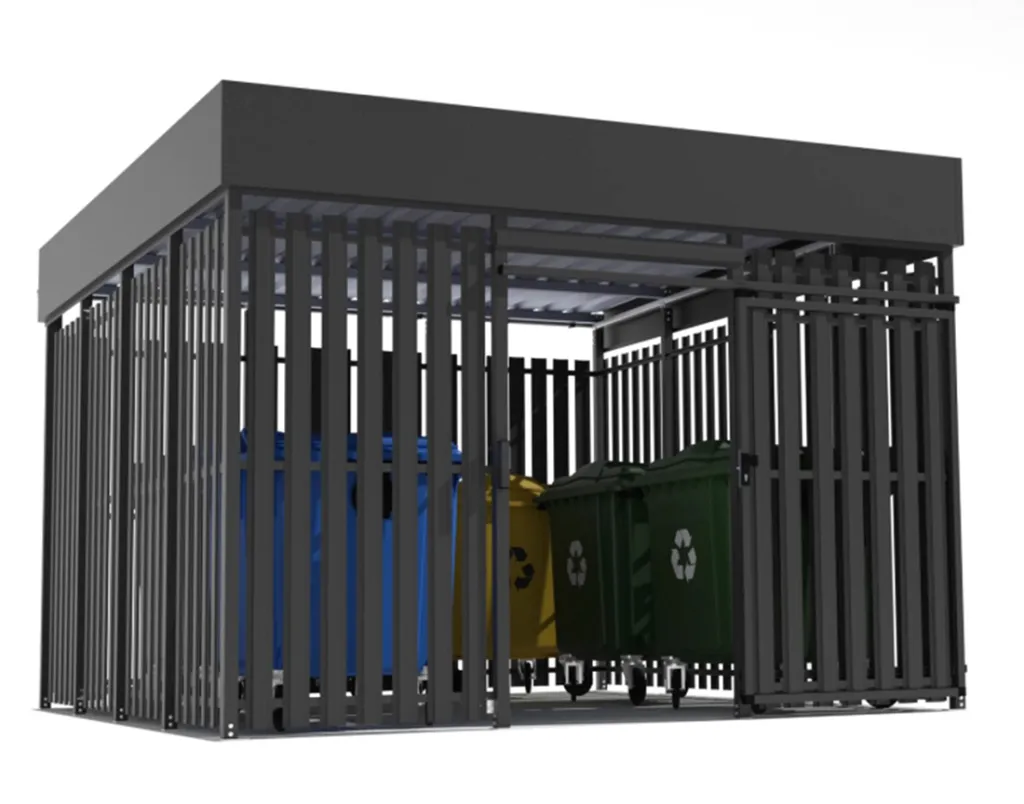
Waste container enclosure
Custom-made waste container enclosure
The waste zone is often the first thing visible near a building – and unfortunately, it can also be the place that most easily gets out of control. When containers stand "in plain sight," the area looks chaotic, and wind and animals can add to the mess. A custom-made waste container enclosure allows you to organize the space, shield the containers, and raise the standard of the surroundings without improvising. A well-designed waste enclosure is not only about aesthetics but also about hygiene and user convenience.
Why a waste enclosure improves aesthetics and order
Waste container enclosures organize waste management: they define a permanent zone, limit the "spilling" of trash around, protect against precipitation and wind, and make access difficult for unauthorized persons. In practice, everyone gains: residents (because the place is cleaner and more predictable), managers (because it's easier to maintain order), and service crews (because container logistics is simpler).
What a custom-made waste container enclosure involves
"Custom-made" means matching three things:
-
the number and type of containers (segregation often requires several fractions),
-
accessibility – how residents enter and how containers are wheeled out,
-
collection logistics – whether and how the waste collection vehicle approaches.
In practice, the dimensions and the type of housing are determined during the consultation stage, so that the structure is consistent with the surroundings and technical requirements.
Materials and durability of the waste container enclosure
Waste enclosures work outdoors all year round, so durability matters. The structure can be made of durable materials (aluminum or steel), and the housing is matched to the aesthetics of the housing estate. Materials are selected so that the structure withstands weather conditions and intensive use (frequent opening, moving containers, maintenance).
Ventilation and types of wall cladding
Enclosures that combine aesthetics with ventilation work well. That's why different types of walls are found: solid, openwork, or made of slats. Slats and openwork solutions allow for airflow, which is important in daily use, and at the same time visually "organize" the zone because the containers are less visible.
Access to the enclosure – open or lockable
Depending on the location, the enclosure can be publicly accessible or with restricted access. When there is a problem with illegal waste dumping or use by outsiders, locking makes sense. Locked doors with code or key access are possible, as well as key door variants for restricted access. This solution works particularly well in housing estates where the waste zone is meant to function "for its own."
Roof and protection against weather conditions
Roofing is not a detail – it's practical. Sloping roofs facilitate water drainage and help keep the whole structure in better condition, and the containers are less exposed to precipitation. The enclosure is also meant to protect against the wind, which can "pull out" light waste, and against animals that may dig through the contents of the containers.
Waste collection logistics – a key element of the project
The biggest game-changer is planning waste collection. An enclosure may look great, but if it is not possible to conveniently wheel out the containers on collection day, frustration begins. Sliding options can be a solution, facilitating the entry of waste collection vehicles. Even with enclosures without sliding elements, it is worth considering the width of the entrance, the direction of door opening, and space for temporary placement of containers on collection day.
Waste segregation and spatial organization
Modern housing estates usually have several waste fractions, plus bulky items and periodic "actions" (e.g., electronic waste). Therefore, a custom-made waste enclosure should take into account not only what stands there today, but also how the zone will function during the season and over the course of the year. Good practice is to provide space for a convenient approach to each container and for possible rearrangement of the layout when segregation rules change. It is also worth planning information boards and fraction markings right away so that users don't have to guess where to throw waste.
Lighting and waste zone markings
The waste zone is used in the evening as often as during the day. Lighting (even simple and energy-efficient) reduces the number of segregation mistakes and improves safety. Additionally, it facilitates work for service crews on collection day. If the area is dark, this is one of those additions that is truly felt in daily use.
Integration with other modules
Enclosures are an element of street furniture – the better you plan them as a single "zone," the fewer accidental objects appear on the site. In practice, it often pays off to combine solutions: a waste enclosure plus a bicycle shelter or another module in one point. You gain a consistent look, easier navigation through the area, and fewer space conflicts.
Installation and ground preparation
Every location is different, so the structure must be adapted to the ground and terrain. In practice, this means selecting the method of anchoring and checking if the zone does not conflict with pedestrian paths, service access, and parking spaces. If the enclosure has doors, the space "to open" and the convenience of carrying waste bags inside are also important.
Maintaining order and operation
A well-designed enclosure helps maintain cleanliness, but it is also worth considering simple things: the possibility of easily washing the floor in the zone and solutions that limit the blowing around of light waste. These are small details that determine whether the zone still looks good after several months.
Who is a custom-made waste container enclosure for
It is most often used by housing estates and communities, but also office buildings, workplaces, schools, and public utility facilities. In each case, the goal is similar: an aesthetic, functional waste zone that does not spoil the image of the place. For developers, it is also an element of the investment standard – it's better to design a consistent zone right away than to "patch" the problem later with a temporary solution.
Common mistakes when designing a waste enclosure
In practice, three things cause the most trouble: a design that is "too tight" without room for maneuvering containers, a lack of ventilation in a tightly enclosed structure, and a failure to account for waste collection access. The good news: all of this can be caught at the design stage if you gather a proper brief and show the location.
The process of ordering a waste container enclosure
Most simply: you provide the number of containers and the type of segregation, describe the location and the method of waste collection, and then you receive a custom-fit proposal. After approval, the completion date and installation are set. If the zone is to be locked, the type of access (key/code) and the method of user organization are determined immediately.
Quick start tip
To get an accurate quote, prepare: the number and type of containers, approximate zone dimensions, photos of the location, and information on how the waste collection truck approaches. If you have guidelines from the manager, include them – it's easier to match the aesthetics and housing details.
Do you want your waste zone to finally look decent? Send the basic data (containers, photos, dimensions, and collection access), and you will receive a proposal for a custom-made waste enclosure. This is a solution that makes a difference every day – both in terms of image and utility.
